

Who Should Bear the Costs of a Dream?
You’ve probably dreamed of traveling into outer space someday. Who hasn’t? However, this is a dream that has rarely come true since man first set foot on the Moon in 1969. At that time, buoyed by the rapid evolution of space rockets, the public believed that life in space was the next step in history. Scientists and writers predicted that the establishment of colonies on the Moon would become a reality as early as the 1980s, and that by the year 2000, space tourism would be available to everyone at affordable prices. However, few predictions made throughout history have proven to be so far from reality.
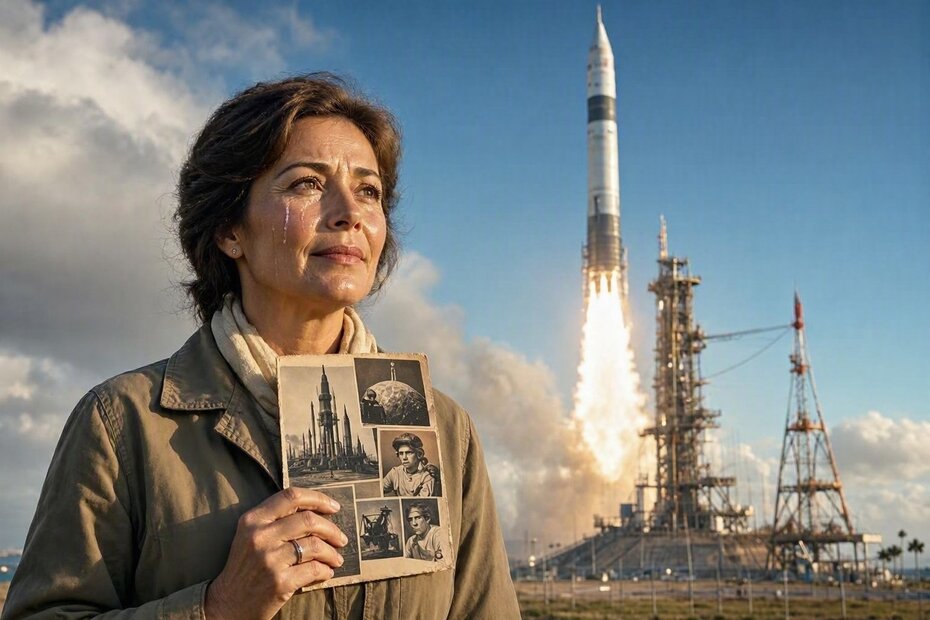
illustration by Bing Image Creator
When I speak of plans for the future of space exploration, I am not referring to predictions made by laypeople. Werner von Braun, NASA’s chief rocket engineer, drew up a detailed design in the 1950s for a ring-shaped space station that was to be built as early as 1963. In the 1960s, the U.S. Army and Air Force developed the Horizon and Lunex projects to build a military base on the Moon with 12 soldiers and an underground colony with 21 residents. Krafft Ericke, a German aerospace engineer and one of the greatest enthusiasts of space colonization, predicted in that same decade the creation of nuclear-powered orbital hotels by the end of the 20th century.
If you were born in the 1960s, you surely remember the cartoon “The Jetsons,” created by the American animators Hanna-Barbera, which depicted the daily lives of ordinary families living in space colonies and traveling through outer space at will in small private rockets.
However, these predictions proved to be completely unfounded when the space race revealed that space was profoundly hostile due to the effects of cosmic radiation and the absence of gravity on the human body, as well as the technical difficulties involved in building closed systems capable of sustaining life. Furthermore, funding for the space race declined dramatically after the first man—an American—set foot on the Moon.
Nothing, however, was more frustrating than watching helplessly as 22 astronauts and cosmonauts died one after another during their space missions, particularly during rocket launches and reentry into Earth’s atmosphere:
• Space Shuttle Challenger (U.S., 1986): 7 fatalities.
• Space Shuttle Columbia (U.S., 2003): 7 fatalities.
• Soyuz 11 (Soviet Union, 1971): 3 fatalities.
• Soyuz 1 (Soviet Union, 1967): 1 fatality.
• X-15 Space Plane (U.S., 1967): 1 fatality.
• Virgin Galactic SpaceShipTwo (Private/U.S., 2014): 1 fatality
• Vostok Capsule / Training Flights (Soviet Union): 2 fatalities
That’s why I could barely contain my shock when I discovered that NASA astronauts—these individuals whose extremely dangerous profession may one day make humanity’s plan to colonize new frontiers in the universe a reality—are burdened by astronomical life insurance costs! Without meaning to play on words here…
So, to avoid having to bear the exorbitant costs of life insurance that would guarantee their families’ current standard of living in the event of their deaths, the astronauts on the Apollo missions came up with a brilliant idea. Before their rockets launched, they spent days signing postcards featuring images from the mission. These postcards were left with the NASA ground crew, who took them to the post office to be sealed and stamped on the days of the spacecraft’s launch and landing, and delivered to the astronauts’ families with instructions to sell them to the public in the event the crew did not return safely.
Many of these postcards were distributed as souvenirs among family members, friends, and associates. However, some can still occasionally be found at auctions of space mission memorabilia, where they are sold for prices that today range from $20,000 to $50,000. These cards serve as a reminder that every grand plan of humanity rests on the superhuman efforts of individuals who struggle against adversity to make them a reality.
Translated to english by DeepL (free version)
Voltar