
Vercingetorix, the High King of the Gallic Warriors
Did you know that the character Asterix was based on a Gallic warrior whose story we know only from the final nine months of his life, when he fought to drive the Romans out of central Gaul? Learn here about the story of this glorious figure, who became the symbol of French resistance against foreign invasions.
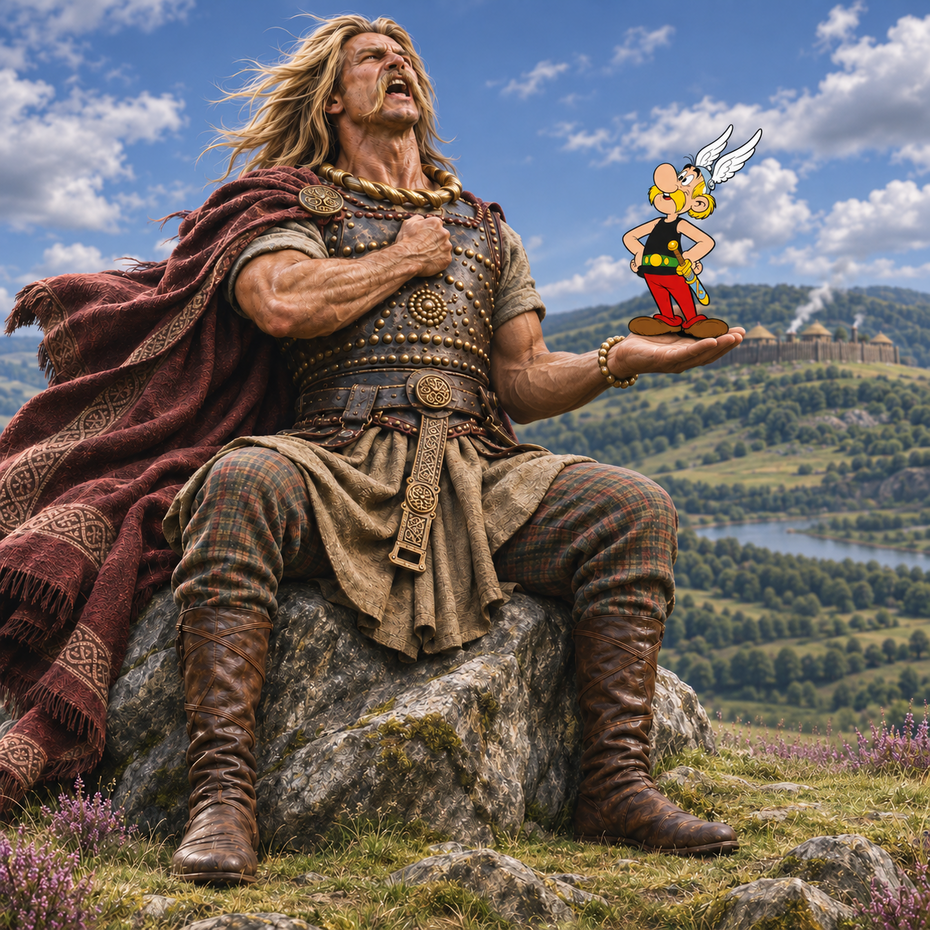
Vercingetorix and Asterix (by chatGPT)
Vercingetorix was a Gallic aristocrat who, in 52 B.C., succeeded in uniting various peoples of Gaul to fight against the Roman invasion.
Although his military glory lasted only the nine months during which he led the Gauls in their battles against the Romans, his fame has endured through the centuries.
But it was especially in the 19th century that Vercingetorix became a French national hero. Napoleon III, committed to constructing a historical narrative about France and its origins, sponsored archaeological research and tributes to the Gallic warrior. Since then, Vercingetorix has come to symbolize French resistance against foreign invasions.
When René Goscinny and Albert Uderzo created the famous character Asterix in 1959, they drew inspiration from the spirit of resistance embodied by this Gallic hero. However, instead of creating a tall, muscular character—as Vercingetorix is usually depicted—Goscinny opted for a small, cunning, and irreverent hero.
Despite the imposing and masculine image that occupies the French collective imagination—enshrined by Aimé Millet’s 1865 statue—Vercingetorix’s true appearance is not known with certainty. His long hair, large mustache, muscular build, and clothing reflect the 19th-century romantic conception of the Gallic warrior far more than any precise knowledge of his actual appearance.
There are no paintings or sculptures recognized as portraits of the hero made during his lifetime or shortly after his death. The only possible contemporary depictions of Vercingetorix are found on coins. Some of those minted under his authority feature the figure of a man with curly hair and a clean-shaven face, although it cannot be confirmed that this is a portrait of him.
But, after all, what achievements made Vercingetorix so glorious?
He was probably born between 82 and 74 B.C., among the Arverni, a people who inhabited the mountainous region of Central Gaul. His people had fertile farmland, raised livestock, and maintained important trade relations with other Gallic peoples and the Mediterranean world. The Romans referred to much of the still-independent Gallic territory as “Hairy Gaul” (Gallia Comata), in reference to the customs of its inhabitants. Unlike the Romans, who generally kept their hair short and their faces clean-shaven, many Gallic warriors grew long hair and thick mustaches.
Almost everything we know about Vercingetorix’s military career comes from the accounts written by his enemy, Julius Caesar. It is believed that, for some time, the Gaul frequented the Roman general’s military circle, as the general hoped to count on his support.
His father, Celtillo, was an extremely wealthy and influential aristocrat who aspired to become king. However, he was ultimately sentenced to death by his own countrymen.
When Julius Caesar began his campaigns to conquer Gaul in 58 B.C., some tribes resisted, while others formed alliances with the Romans. The Romans, however, began to interfere increasingly in the lives of the Gallic communities, demanding resources and subjugating territories, which sparked deep discontent.
In early 52 B.C., the Carnutes attacked the city now known as Orléans, killing merchants and other Romans settled there. Vercingetorix, realizing that Caesar was occupied with political matters in Italy, decided to seize the opportunity and called upon his supporters to expel the invaders from Gallic lands.
However, many aristocrats considered the initiative too risky, including members of his own family. Expelled from Gergovia, Vercingetorix recruited his first fighters from among the poor and marginalized, according to Caesar’s account. Gradually, he won over new supporters, gathered sufficient forces to drive out his opponents, and was proclaimed king by his followers.
Vercingetorix knew that the Romans depended on the settlements along their route to supply themselves with food and other resources. For this reason, he began to adopt the strategy known today as the “scorched earth” policy: he ordered his allies to destroy farms, food stores, and villages that could serve as supplies for the enemy, even if they belonged to the Gauls themselves. Julius Caesar recorded that more than twenty Bituriges settlements were set ablaze in a single day!
The Bituriges, however, refused to destroy Avaricum, one of their most beautiful and important cities. Vercingetorix eventually yielded to their pleas. When Julius Caesar laid siege to the city, conquered it, and massacred a large part of its population, the Gauls recognized that Vercingetorix had been right. The tragedy ultimately strengthened his authority.
Shortly thereafter, the Gauls won an important victory in the battle to defend Gergovia. Julius Caesar, who had intended to take the city, suffered heavy losses and was forced to retreat.
At an assembly held in Bibracte, Vercingetorix was then confirmed as commander of the great Gallic coalition. However, the next major confrontation would mark the end of his military career.
After suffering a defeat in a cavalry engagement, Vercingetorix took refuge in the fortified city of Alesia, where he and his 80,000 fighters found themselves trapped in an ingenious trap. The Roman general ordered the construction of two lines of fortifications around the city, situated atop a hill: the innermost line prevented the Gauls from leaving the besieged city, while the outer line protected the Roman legions from any armies that might come to the aid of those under siege.
With the failure of the troops sent to free him, the depletion of supplies, and the impossibility of breaking the siege, Vercingetorix surrendered to the Romans, likely in September of 52 B.C.
According to the account of the historian Plutarch, written long after the events took place, Vercingetorix donned his finest armor, adorned his horse, and rode to the spot where Julius Caesar was seated. After circling the Roman general, he dismounted, removed his armor, and sat at Caesar’s feet.
The defeated commander was taken to Rome, where he spent six years in captivity, likely in an underground prison. In 46 B.C., he was paraded by Caesar as a human trophy in a public ceremony intended to celebrate the Roman general’s victories. He was then executed.
Vercingetorix’s defeat at the Battle of Alesia marked the end of the Gauls’ major organized resistance, although it would still take the Romans about two years to quell the last pockets of rebellion.
Gaul remained under Roman rule for approximately five centuries, a period that brought about a profound cultural, political, economic, and linguistic transformation of the territory we now know as France.
It is precisely in the year 50 B.C., when the Roman conquest of Gaul was practically complete, that the creators of Asterix set the adventures of their little warrior. In a fictional village of indomitable Gauls, resistance to the Roman invaders would never come to an end.
Thus, it fell to Asterix, nearly two thousand years later, to perpetuate in the world of fantasy the resistance that Vercingetorix was unable to lead to victory.
Voltar