


People Just Like Us
Let me pose a riddle.
I’m going to describe the daily lives of a group of women, and you’ll tell me what era I’m talking about.
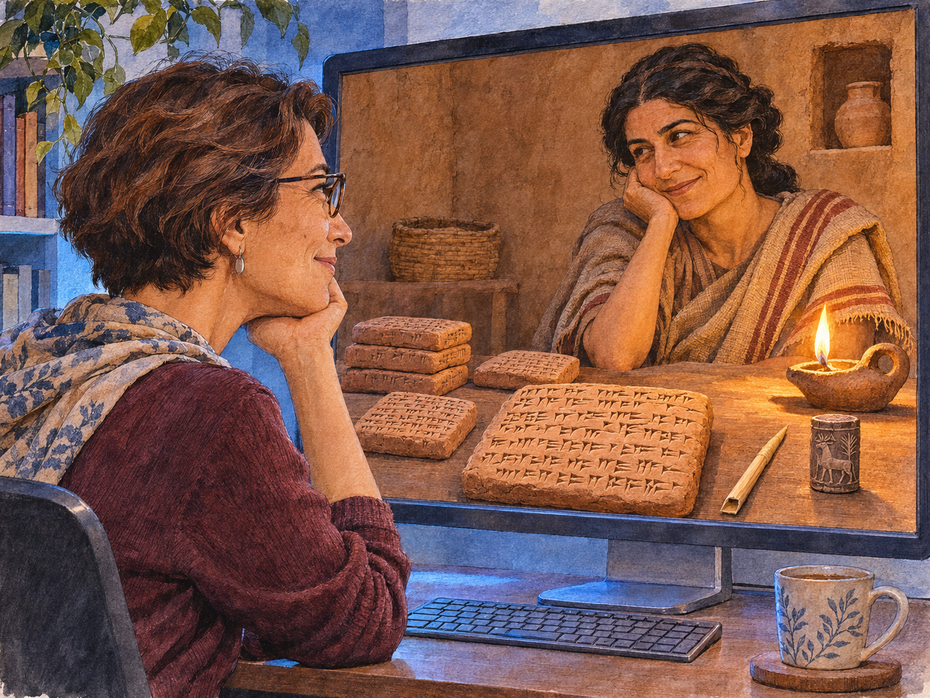
Two women look at each other across the computer screen (by chatGPT)
They were married; many had several children; and their husbands spent long periods in distant cities, seeking good business opportunities. They went months without seeing their families.
These women could receive inheritances, lend money, and buy real estate. In their town, both they and their husbands could file for divorce by paying equivalent compensation.
In addition to taking care of the home and children, they worked to help support the family. While their husbands were away, they also had to manage businesses, pay taxes, and collect from delinquent customers.
I imagine these women at night, after the children had gone to bed and the house was finally quiet, writing by candlelight to their husbands.
In their letters, practical matters mingled with complaints, longing, and loneliness.
But not all of them received the understanding they hoped for. Despite their efforts to keep everything running smoothly, some faced criticism and accusations that they spent too much. As if taking care of everything on her own were easy...
So? Do you have an answer yet?
Maybe the 1970s or 1980s? After all, they seem to have quite a bit of autonomy, but they still have large families and communicate by letter…
Well, these women lived about 4,000 years ago, in ancient Assyria, in northern Mesopotamia!
The letters were written on wet clay tablets, with cuneiform characters etched using the tip of a reed. The envelopes, also made of clay, were marked with cylindrical seals that identified the senders. Transported by donkey, they could take up to six weeks to travel about 1,000 kilometers.
Historian and archaeologist Cécile Michel studied this correspondence and pieced together the stories of women whose concerns seem much less distant from our own than the timeline suggests.
Click here to read the CNRS article that tells these stories in detail and features images that are well worth seeing.
Voltar