


What if the Phoenicians had discovered Brazil?
What if everything you learned in history class were wrong? What if the one who truly discovered Brazil was Baal-Eser II, king of Tyre, in the 9th century B.C.?
That is the possibility explored in the following short story, inspired by the suspicions attributed to Friar Custódio during the reign of King João VI.
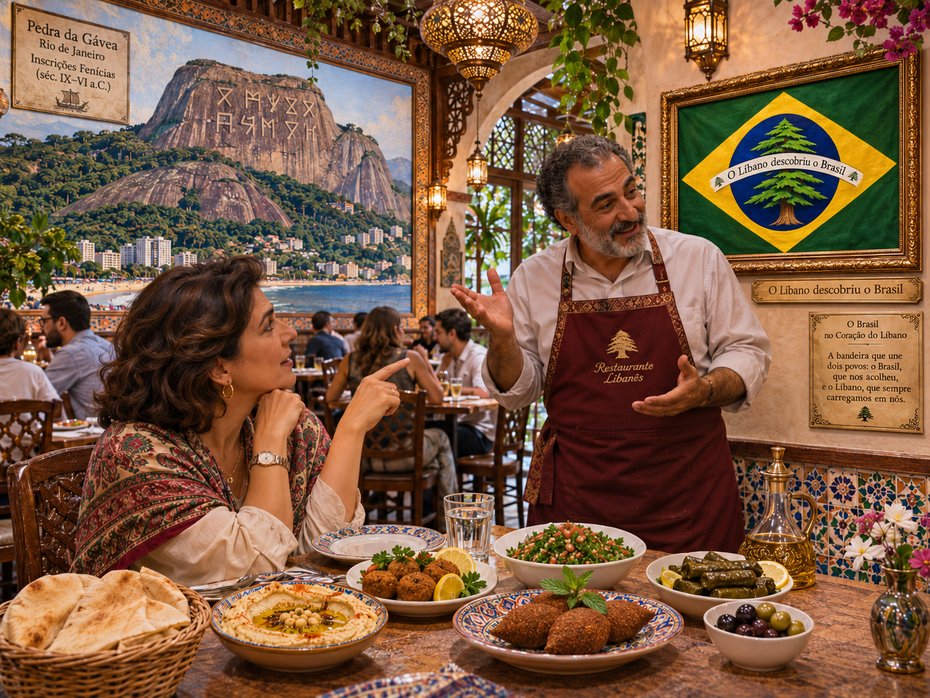
Interior of a lebanese restaurant and a new bazilian flag (by chatGPT)
It was just past noon when I walked into my favorite restaurant in Copacabana. As a longtime regular, I was always shown to the best table, where they served me my usual dish without my even having to order.
That day, however, something had changed. The frames containing family photographs, newspaper clippings, and Lebanese landscapes had disappeared. In their place, a huge mural depicted Pedra da Gávea, with São Conrado Beach at its feet. Giant Phoenician characters stood out at the top of the cliff.
I spent my lunch intrigued by that painting.
When the owner approached, bringing the check on a tiny bronze plate, I couldn’t resist:
“Did you decide to change the decor, Mr. Tarek?”
“That’s my son’s doing—he’s studying history at UERJ. He’s been researching some documents in the Metropolitan Cathedral’s archives...”
“No way! And what did he discover?”
“Letters from a friar to Dom João VI!”
“But what does that have to do with the decor?”
“Bear with me, and I’ll tell you.” And if you help me spread this story around the world, you’ll eat for free at this restaurant for the rest of your life!
— Wow! I’m all ears!
— It all began in the 1820s, when Friar Custódio, a scholar well-versed in Greek and Eastern languages, heard rumors about strange inscriptions on Pedra da Gávea. Hunters and farmworkers who frequented the Horto Real region claimed to have seen enormous characters carved into the rock.
Intrigued, the friar decided to investigate. Armed with a telescope and his drawing supplies, he joined a group of adventurers who knew the region.
The journey, which combined rough trails and stretches traveled by canoe, took several hours. Finally, on the sands of São Conrado Beach, Friar Custódio set up his telescope on a tripod and aimed it at the top of Pedra da Gávea.
What he saw left him amazed: those grooves really did look like characters from an ancient language!
The friar reported his discovery to the court, but it was not until 11 years later that the supposed inscriptions were investigated. In 1839, a commission from the newly created Brazilian Historical and Geographical Institute was sent to the site, but its members concluded that they were likely natural formations.
Nearly a century later, the Amazonian archaeologist Bernardo Ramos revisited the issue. A scholar of Brazilian rock inscriptions, he interpreted the grooves as Phoenician characters referring to an ancient king:
“Tiro, Phoenicia, Badezir, firstborn of Jethbaal.”
— What’s this all about, Mr. Tarek? I’ve never heard that the Phoenicians had been around here!
— Well, there were those who argued that they reached Brazil many centuries before Christopher Columbus!
— But who was this Badezir?
— Baal-Eser II, also known as Badezir, was king of Tyre in the 9th century B.C.
At that time, the Phoenicians occupied a narrow strip of land between the mountains and the Mediterranean, where Lebanon lies today. They were great navigators and merchants, famous for their cedar, colored glass, and purple dye extracted from marine mollusks. Their knowledge of the stars allowed their ships to sail across distant seas.
But Tyre’s prosperity was threatened by the advance of the Assyrians. To preserve their trade, its rulers were forced to pay tribute to the powerful King Shalmaneser III.
This is where the most extraordinary part of the story begins.
According to legend, Badezir abdicated the throne in favor of his son Mattan and set off into the unknown on an expedition that combined territorial ambitions with spiritual purposes.
His ship, named Phoenicia, was about twenty meters long, had a large square sail, and was manned by twelve oarsmen who took over during periods of calm.
After crossing the Strait of Gibraltar, the sailors sailed along the African coast and past the Canary Islands. Driven by the trade winds, they crossed the Atlantic until they reached the Brazilian coast. From there, they headed south, searching for a passage to the western seas.
But the long journey took its toll. Shortages of water and food, disease, and storms decimated part of the crew. As they sailed along the coast of what is now Rio de Janeiro, King Badezir himself died.
His men then sought a fitting place to bury him.
That was when they spotted a gigantic rock whose shape resembled a human head. There could be no grander monument for their king!
They decided to bury him there.
Suspended by ropes and armed with chisels and hammers, the artisans worked for weeks, carving an inscription into the rock that identified the royal tomb.
“Wait a minute, Mr. Tarek. Are you telling me that Pedra da Gávea is the tomb of a Phoenician king?”
“And what a tomb!” he exclaimed loudly, drawing everyone’s attention. “Not even the pharaohs had a monument like that!”
“Near the base of the head, the artisans took advantage of a natural recess to carve a monumental portal, which, according to later esoteric interpretations, was said to represent the entrance to the world of the dead: the so-called Portal of Agartha.
Once the task was completed, the survivors set sail back home. But the winds at those latitudes did not favor the return journey...
The Phoenicia vanished into the Atlantic, taking with it all those who knew the tomb’s secret.
— What an extraordinary story, Mr. Tarek!
— And mind you, the portal and the inscriptions are still there, for anyone who wants to see them! But the skeptics insist that it’s all just marks left by the passage of time...
“You mean Brazil might have been discovered by the Lebanese?”
“Exactly! That’s why I designed a new flag for this country. I replaced the stars with the Lebanese cedar, in honor of Brazil’s true discoverer.” “Just look how beautiful!” he said, pointing to the wall in front of me.
“Mr. Tarek, I don’t know if this story is true. But if I post it on my blog, will you keep your promise?”
“What promise?” he asked, waving the check a few centimeters in front of my nose, laughing mischievously.
Voltar