
The Voice of the Womb (Tales of Taquiti 3)
In this chapter of the Tales of Taquiti, the indigenous woman Játáti faces a pregnancy in which the boundaries between reality, dreams, and delirium slowly begin to blur, leading her to believe that her child is extraordinary.
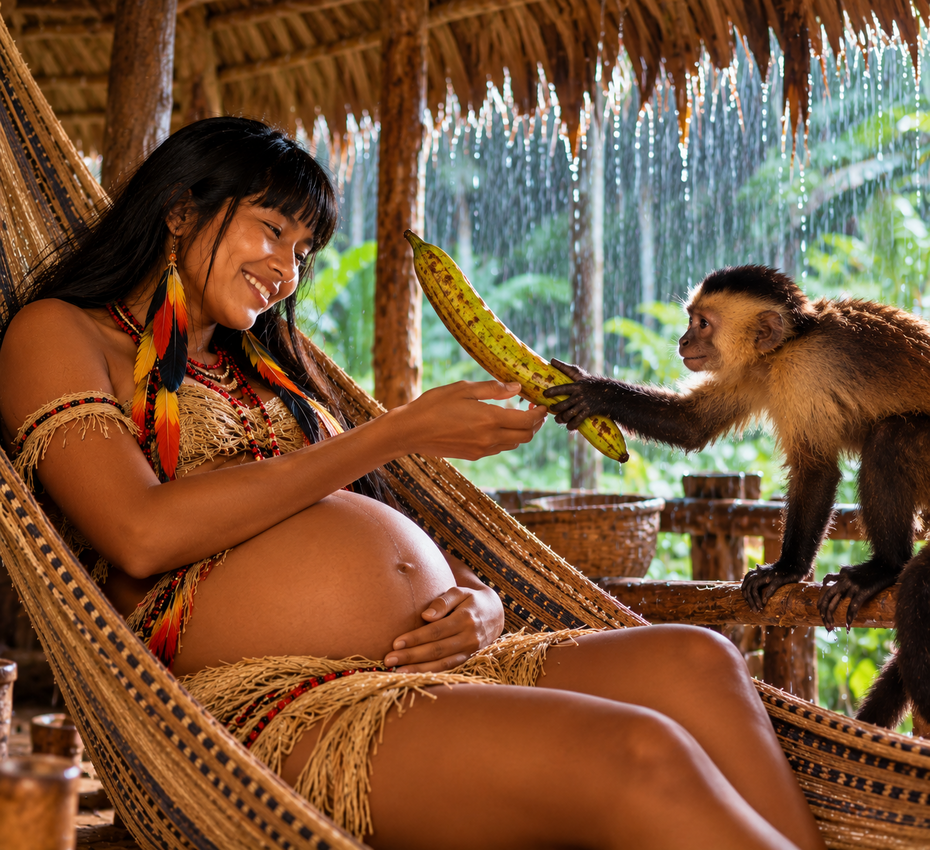
Illustration of a pregnant indian woman receiving an ingá from a monkey (by chatGPT)
Dawn had not yet fully broken when Takwyiti left the village. The rain had been falling steadily since the early hours of the morning, creating small streams along the path. She walked barefoot. Her feet were accustomed to the uneven terrain—to every protruding root she had to step around to avoid tripping, to the low-lying areas where puddles of mud formed on rainy days like this one. The red earth, softened by the rain, gave way beneath her heels and seeped between her toes. Every now and then, she had to stop to remove a leaf or a twig that had become lodged on the sole of her foot. Takwyiti walked unhurriedly, but without hesitation. She had known that route since she was a girl.
As she approached her employer’s house, the rain seemed to let up. She then ran her nimble, calloused fingers through her hair and smoothed out the strands in an attempt to improve her appearance a little. Next, she smoothed out the little calico dress that clung to her wet body and wrung out its waterlogged hem. Now she was finally ready for another day of work!
When the door opened, the children came running excitedly:
“Nhá Taquiti, will you tell us a story? Please! It’s raining today and we can’t play outside.”
“All right. Let’s calm down, or I won’t remember where I left off yesterday. Oh, yes!” she said as she finished washing her feet and placed them in front of the wood-burning stove to dry.
“The rainy season started early in the middle Tocantins River region that year. The weather seemed crazy: during the amcró season, the drought had been terrible; with the arrival of the ta’ti season, came that endless downpour! But at least the drop in temperature brought by the rains made the Indians feel full of energy: the village buzzed with excitement like a hornet’s nest.
Despite the cooler air, the women were annoyed, for the unexpected end of the dry season had interrupted the burning of the fields. How were they supposed to plant the fields of corn, cassava, and sweet potatoes if the land was still overgrown with brush? That was what Játáti was thinking about that morning as a curtain of water streamed down the thatched roof of her hut and she gathered her strength to begin her day’s work.
With the first rains, sprouts, flowers, fruits, and insects appeared everywhere. The forest was in celebration! The screeches of monkeys rang out from the treetops, and Játáti wondered where Rorê might be. He was already ten years old. He was strong, curious, and independent—hard to control. He spent entire nights in the forest, in the company of a troop of monkeys of his own species, the capuchin monkeys. He only showed up when he was hungry, or when called by his adoptive mother, to whom he remained deeply attached.
As if he’d received a telepathic message from Játáti, Rorê appeared, leaping nimbly from branch to branch until he landed in her lap. His wet body was shivering from the cold. He didn’t hesitate and clung to her to steal a little of the warmth emanating from that body, which had felt like an oven ever since her belly had begun to grow. He was clutching an ingá—the first of the season—brought as an offering for breakfast. Rorê knew full well that she was crazy about ingá and that, because of her pregnancy, she craved fruit all the time.
Játáti woke up that morning feeling unwell. Ever since her belly had started to grow, strange things had been happening to her. After washing her face and hands in the stream, she sat down to eat the ingá that Rorê had brought. She had barely opened the long pod and sunk her teeth into the soft, white pulp surrounding the seeds when she heard a noise coming from her belly. She placed both hands on her belly, taut as a drum, and felt the child wriggle like a little fish, tickling her here and there. She then looked in surprise at Rorê, who was sitting beside her, and asked:
- Did you hear him speak?
The monkey grumbled softly and scratched his head as he looked at her.
“He said he loves ingá and that tomorrow you should look over by the stream, near the grove of jenipapeiros and embaúbas, where the fruits are sweeter.”
“Stop talking nonsense, girl; the -kra who are still in the womb don’t talk to their mothers,” said the shaman’s wife, who knew a thing or two."
- “But my -kra does talk! Last night I saw Kupepuxititi, the Father of the Forest. He appeared to me in a dream and explained what happens every time I bathe in the waters of the stream. I always feel my belly get so light when I enter the water, and the river fills with fish all around me! He told me this happens because my son leaves my belly and turns into a fish. When he gets tired from swimming so much, he goes back into my belly to return to the village and sleep. When I woke up this morning, I could still hear my fish-son floundering in the puddles of rainwater in front of my hut."
The shaman’s wife burst out laughing, incredulous. Játáti then got up, looking glum, and returned to her hut with her head down. “
‘There are days when we shouldn’t even get out of our hammocks,’ said Takwyiti with a pout, looking out the window at the rain that wouldn’t stop falling.’